Written by Chay Bacani-Florencio
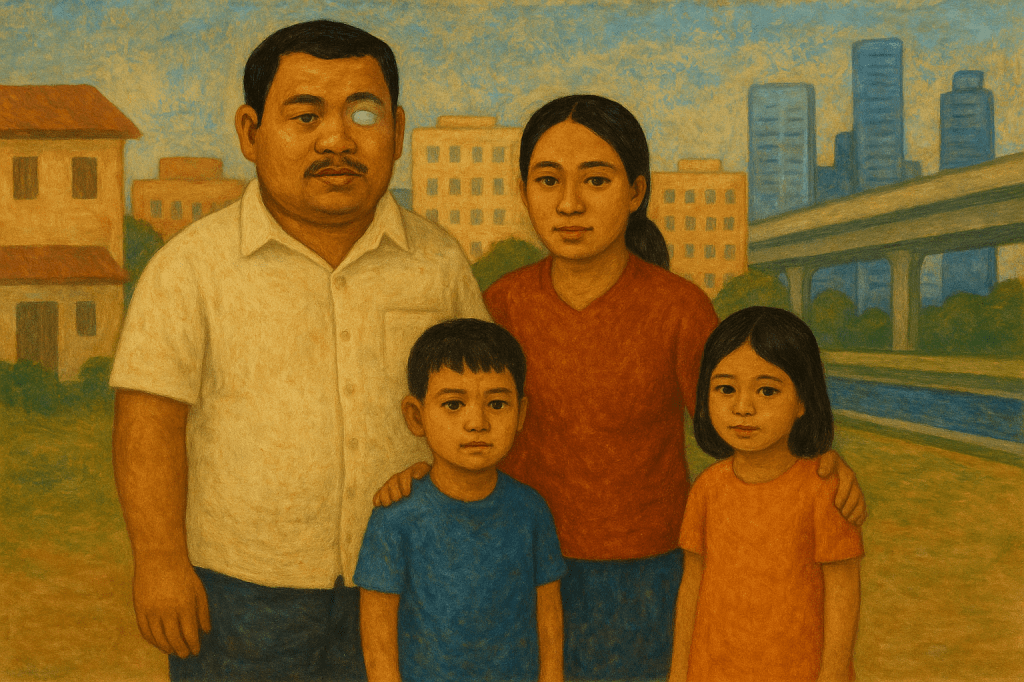
Sok Vannak, 30 years old, dreams of securing a dignified life for his wife and two children in Cambodia. Work opportunities were limited for him in Cambodia in his young adult years, as he never attended formal school. His chances of providing for his family further diminished when he got into a traffic accident that left him with a broken jaw and a visually impaired left eye. With no health insurance or government support, he had no choice but to entirely self-pay for his hospitalisation, exhausting his savings and borrowing money from his friends. Without any means to pay his debts, he took the risk of migrating with his family to Thailand, initially through irregular channels.
The Dangers of Migrating Undocumented
Sok Vannak lacked the resources to go through the proper documentation process. He also fears that he will need to disclose his visual impairment in the health checks as part of the documentation processes and as a result felt he would likely be outrightly rejected. He entrusted his friend who knew about transportation that would bring them to the border and then to an employer who had assured him of a job, with the promise of not having to go through an application process. He, his wife, and their two children, who were seven and five years old at the time, were fetched by a driver who only spoke Thai and was only able to bring them up to the foot of the mountains bordering Cambodia and Thailand. From there, a Thai guide led them to a rendezvous point where they would be picked up again by the same driver. Fearing getting caught by the border authorities, he also recalled going through the trek, terrified of the dangers the mountains hold, especially with two small children by his side. Upon reaching the destination, he paid Thai Baht 3,500 (US$ 110) for himself and for his wife. And, just after a few days to recover, he immediately started as a worker on a durian farm.

Without any written and binding contract and refusing to disclose that he is a person with a disability, Sok Vannak toiled on the farm undocumented and therefore at higher risk of labour rights violations. It was through this first work experience that he learned about the value of applying for work and documentation through proper channels, as he was dismissed under allegations that he was not working as fast as he should. He then went to work for another durian farm, and this time, he chose to disclose to his employer that he was without a passport and work visa, and that he has visual impairment.
The Abusive Cycle of Debt Bondage
Sok Vannak still does not have a written employment contract with his current employer as of end-2024. As his wife also chose to work on the same farm, he accepted their employer’s offer to pay for their work visa and passports, on the condition that the total amount of Thai Baht 4,000 (US$ 125 each) comes off their monthly salary. This scenario is not new, as his coworkers were also offered the same arrangement – assistance in document processing in exchange for payment deducted from their labour that may extend for an uncertain and potentially exploitative length of time. Some Sok Vannak reported that some of his colleagues have made the move of leaving the job, with the risk of getting caught not just by the surveillance cameras, but also by the police, with whom the durian farm owner has gained favour. He believed they wanted to leave the farm for good, but their debts to the owner kept them from leaving formally.
The Risks of Unregulated Employment

Although Sok Vannak was not treated with discrimination by his second employer in Thailand, he has experienced unregulated work hours, delayed payment of wages, and looming uncertainty of unending debt. These are not only detrimental to his mental health but also place him in a position of precarity shared with many other undocumented migrant workers.
His situation, as a worker with a visual disability could have been improved through open dialogue with his employer for the provision of reasonable accommodations, such as orientation to the workplace (e.g., clear pathways, proper lighting or tactile markers), clear safety information and peer or job coach support, that would also translate to wider protections for migrant workers.
In addition, all workers in agriculture need humane work hours, secure and comfortable employer-employee relations, and protections for migrant workers who are in the process of being fully documented. This aspiration for strengthened protections aligned with international labour standards will allow for the rightful enjoyment of fair wages and safe workspaces for migrant workers with disabilities, without fear for their exploitation and discrimination.
Images generated with assistance of OpenAI, images conceptualized and final edit by Ferdinand Paraan Jr.
 Disability Migration Network (DMN)