Building on the assessment: what disability-responsiveness should mean for the Global Compact for Migration (GCM) (please download for full accessibility)
Easy Read Version (please download for full accessibility)
This qualitative study explores how the Global Compact for Safe, Orderly and Regular
Migration (GCM) can be made more disability-responsive, building on the Disability Migration
Network’s (DMN) prior analysis and forthcoming DMN and International Labour Organization
(ILO) publication on disability and labour migration in ASEAN. While the GCM promotes rights
based migration governance, disability is mentioned only in three of its twenty-three
Objectives, leaving significant conceptual and operational gaps. Drawing on four focus group
discussions with Organisations of Persons with Disabilities (OPDs) in Cambodia, Myanmar, the
Philippines, and Thailand, the study identifies what disability-responsiveness means in
practice and how it can be integrated across migration policy. Findings reveal that migrants
with disabilities and acquired disabilities feel marginalised throughout the migration process,
facing inaccessible systems, limited participation, and weak institutional support. Participants
emphasised that protection and empowerment must function together: …
Disability-Responsiveness of Fair Recruitment: The Situation for Migrant Workers with Disabilities (please download for full accessibility)
Easy Read Version (please download for full accessibility)
This paper applies a disability-responsive lens to the concept of fair recruitment within international labour migration frameworks, particularly referencing the ILOs General Principles and Operational Guidelines for Fair Recruitment (GPOG). Despite international commitments to promote fair recruitment, migrant workers with disabilities remain largely invisible within governance frameworks and recruitment practices, facing systemic discrimination and exclusion. The report examines the intersection of disability, labour migration, and fair recruitment, mapping the employment landscapes in countries of origin, analysing regulatory frameworks, and identifying disability-specific barriers throughout the migration cycle. A thematic content analysis of the GPOG benchmarks its alignment with the CRPD and the ILO’s Global Business and Disability Network (GBDN) Charter Principles. The paper concludes with practical recommendations aimed at strengthening data collection, advancing disability-responsive laws and policies, promoting accessible recruitment practices, and empowering migrant workers with disabilities.
Assessing disability-responsiveness of the Global Compact for Safe, Orderly and Regular Migration (GCM) (please download for full accessibility)
Easy Read Version (please download for full accessibility)
The Global Compact for Safe, Orderly, and Regular Migration (GCM) provides pathways for States to respect, protect and fulfil the rights of all migrant workers. However, there remains a pressing question regarding the adequacy of its provisions for addressing the specific needs of persons with disabilities throughout their migration journey. Through a qualitative content analysis, this research investigates the GCM Resolution alongside four other related migration documents, examining the extent to which the GCM has conceptualised and operationalised disability-responsive measures. The analyses reveal that disability issues in migration remain underexplored with insufficient provisions to mitigate disability-related inequalities and discrimination. There is evidence of a minimal symbolic inclusion but no identifiable impact in reality. Despite the GCM having disability-responsive provisions within the document, these provisions appear to lack clarity, and this lack of clarity potentially impacts the lack of …
The labour migration cycle from the perspective of Filipinos with disabilities (please download for full accessibility)
Easy Read Version (please download for full accessibility)
This pilot study explores the often-overlooked experiences of Filipinos with disabilities within the international labour migration cycle, addressing a critical gap in migration scholarship. Through in-depth interviews with four participants—prospective migrant workers with disabilities, migrant workers with disabilities, and migrant workers with acquired disabilities—the research uncovers barriers that span physical, social, institutional, and communicational dimensions. Key themes were generated, including navigating migration pathways, the impact of systemic reservations in the country of origin, challenges within recruitment and employment processes, and the lived realities of migrant workers abroad. The findings emphasise the urgent need for disability-responsive measures as envisioned in the Global Compact for Safe, Orderly and Regular Migration (GCM), in Objectives 7, 15, and 20. By spotlighting the inequities and exclusions faced by persons with disabilities, this study spotlights the necessity of inclusive migration policies and practices that address the unique challenges encountered by persons with disabilities across the entire migration journey.
Easy Read Version (please download for full accessibility)
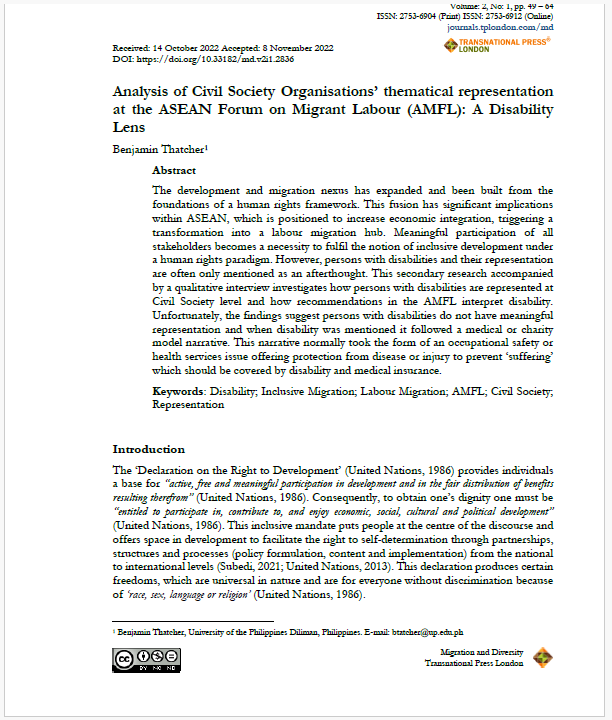
The development and migration nexus has expanded and been built from the foundations of a human rights framework. This fusion has significant implications within ASEAN, which is positioned to increase economic integration, triggering a transformation into a labour migration hub. Meaningful participation of all stakeholders becomes a necessity to fulfil the notion of inclusive development under a human rights paradigm. However, persons with disabilities and their representation are often only mentioned as an afterthought. This secondary research accompanied by a qualitative interview investigates how persons with disabilities are represented at Civil Society level and how recommendations in the AMFL interpret disability. Unfortunately, the findings suggest persons with disabilities do not have meaningful representation and when disability was mentioned it followed a medical or charity model narrative. This narrative normally took the form of an occupational safety or health services issue offering protection from disease or injury to prevent ‘suffering’ which should be covered by disability and medical insurance.
 Disability Migration Network (DMN)