Written by Chay Bacani-Florencio

In April 2019, Aira Ledesma, a 27-year-old teacher from the Philippines and the youngest of seven siblings, traveled to Thailand on a tourist visa to seek employment. Hoping to avoid recruitment agency fees, she relied on a friend already living there to help her find work. Eventually, she was hired as a science teacher for all secondary levels at a school in Northern Thailand. She was offered a contract written in Thai which was verbally translated to her by a third-party agency.
Surviving an Acquired Disability
In the first quarter of 2021, Aira woke up one evening feeling severely dizzy and began vomiting. Before losing consciousness, she was able to ask her housemate to call for an ambulance. At the hospital, she was diagnosed with a ruptured brain aneurysm and later underwent two life-saving surgeries—the first to address the aneurysm and the second to treat hydrocephalus.

The medical emergency resulted in an acquired disability. Aira lost the ability to speak, was bedridden, and became dependent on a feeding tube. She received care from two non-English-speaking caregivers who supported her with basic tasks such as feeding, bathing, and toileting. Her hospital stay lasted less than a month but was deeply isolating, especially being away from home.
Lack of Protection and Support
With no access to health coverage, and a “no work, no pay” employment arrangement, Aira had no means to fund her treatment. Her sister, then working abroad, had to sell her house to help pay over PHP 1 million in medical bills. Additional financial support came from the Pinoy Teachers group, of which Aira was a member. Contributions came also from concerned Thai colleagues. The school processed her remaining salary but offered no further assistance and she was effectively dismissed. When her work visa was revoked, she returned to the Philippines.
Rehabilitation and Reintegration
Back home, Aira accessed 16 physical therapy sessions through the Department of Social Welfare and Development (DSWD), while her family covered additional costs for 10 more. Travel to the rehab center required a three-hour journey by land and sea. Though she stayed with her sister who lives near the facility, she needed her mother’s assistance to use a wheelchair for mobility. She has since later on progressed to using assistive walking devices, allowing her more independence.
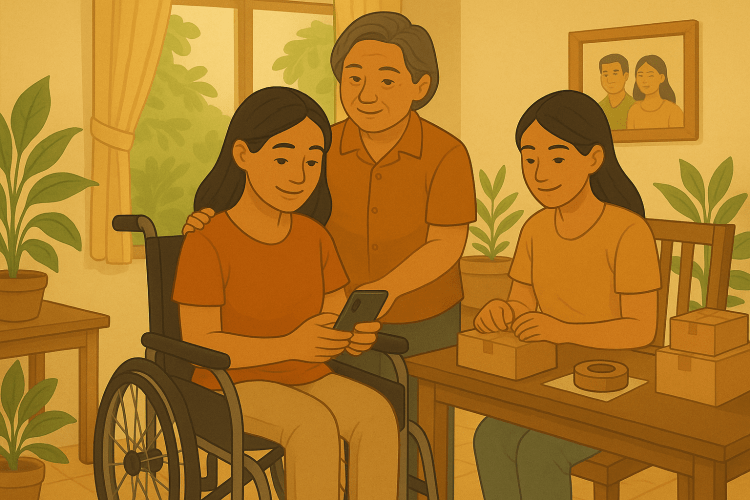
Aira received a livelihood capital from the Persons with Disability Affairs Office (PDAO) to start an online business even though she discontinued her contributions to mandatory social security and health care services provided by the government upon being employed in Thailand. And while her parents and siblings in the Philippines support her in regaining a sense of purpose and well being, she feels that she can no longer go back to her previous vocation of teacher as her speech and mobility are still impaired. She has turned to selling products online – a courageous yet economically unstable move especially since she has become dependent on her family for financial support.
A Call for Inclusive Protections
Aira’s story is a stark reminder of the gaps in labor protections and accessible health care of migrant workers with acquired disabilities while abroad. This case strongly suggests the urgent need for stronger and more inclusive systems to protect the welfare of migrant workers.
Images generated with assistance of OpenAI, images conceptualized and final edit by Ferdinand Paraan Jr.
 Disability Migration Network (DMN)